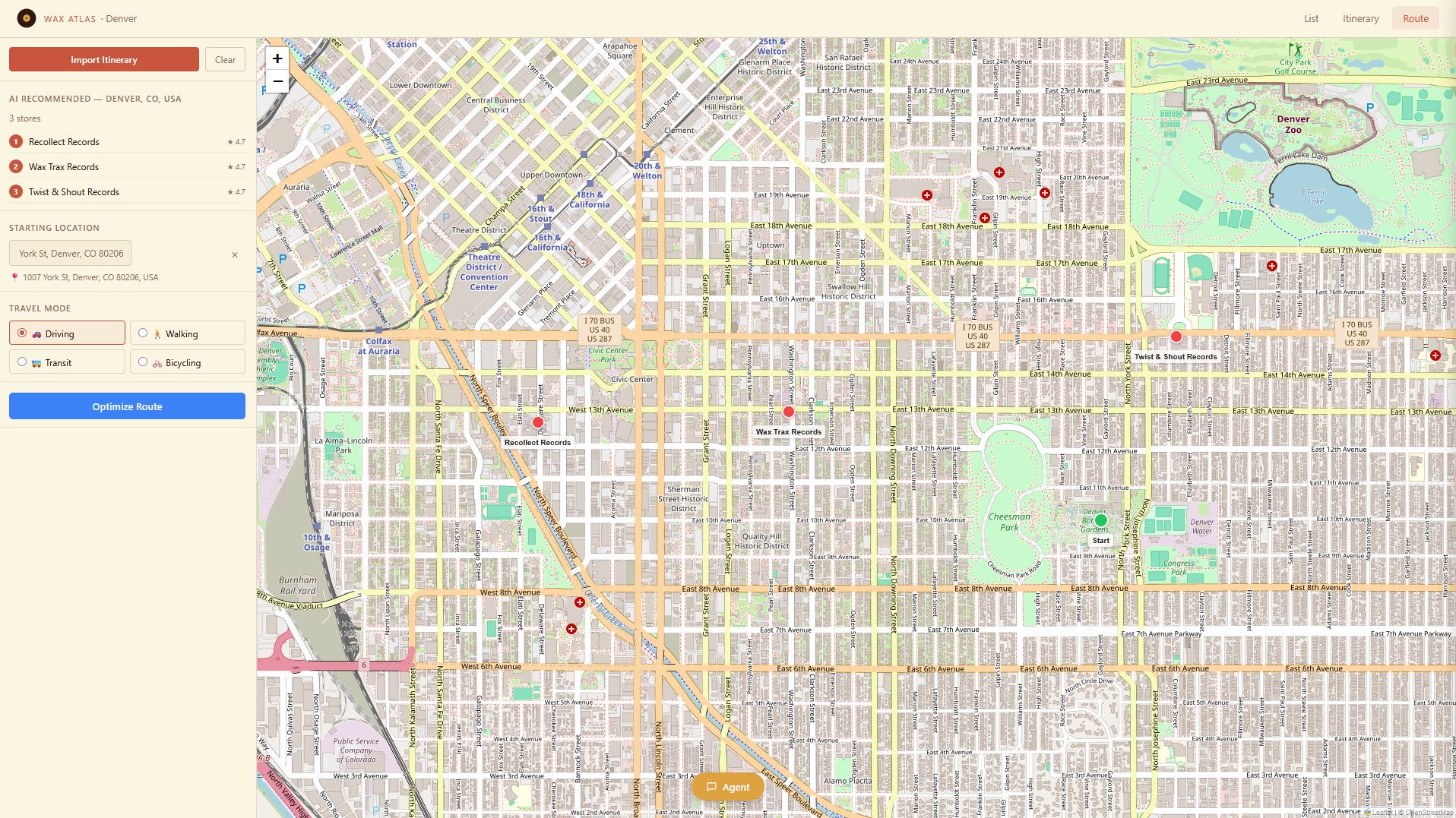
An AI-powered vinyl record store discovery and planning tool.
→
Built to simplify and streamline how I find great record stores to visit when I'm in a new city
→
An onboard AI agent that optimizes route planning based on time constraints or transit preferences (walk, drive, subway)
→
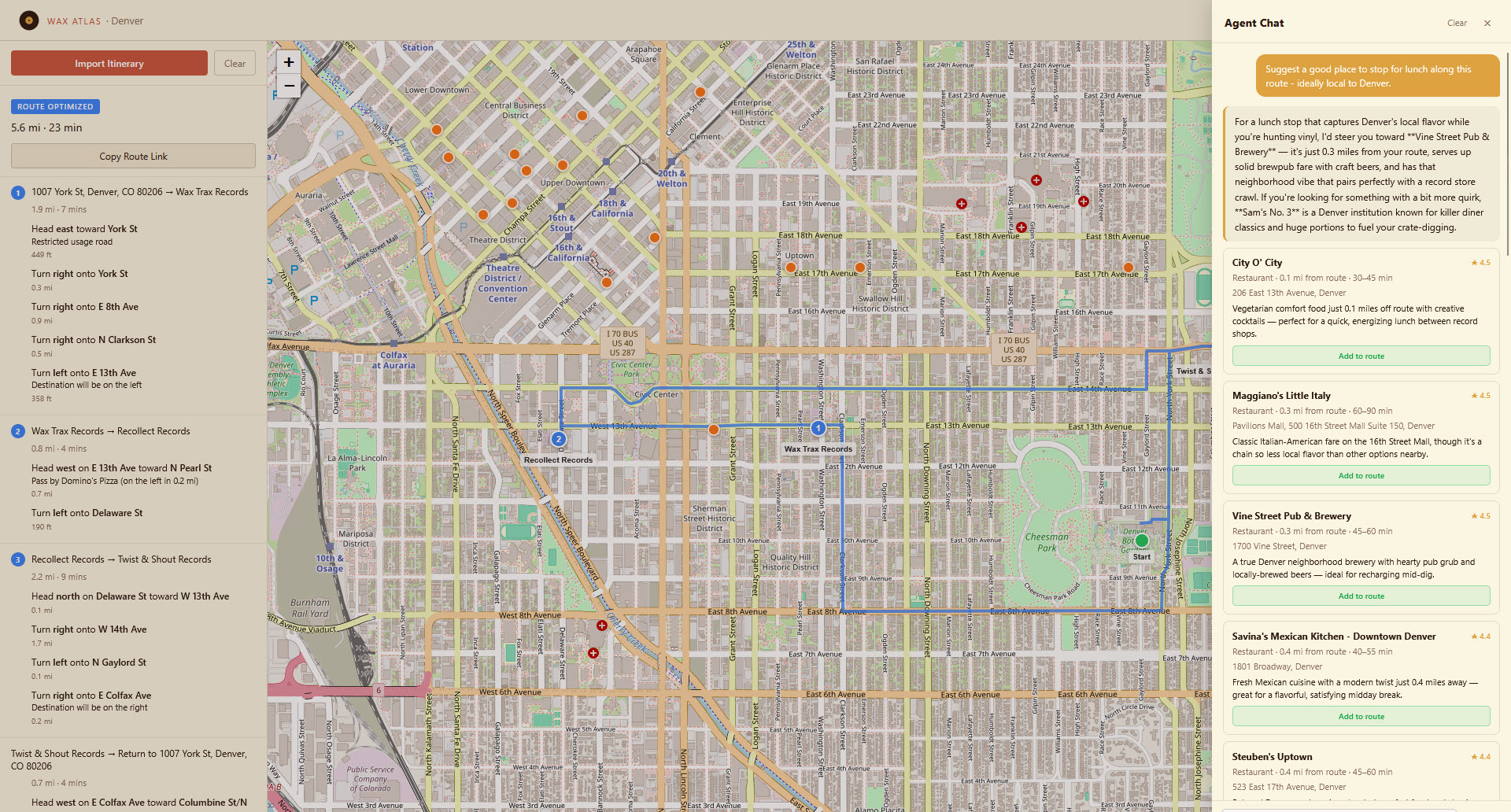
The agent also helps fine tune my route with additional stops, like coffee shops, restaurants or local landmarks depending what I'm interested in that day
Replay
Real World Application
Wax Atlas replaces the need to stitch together various Google searches, online reviews, and store
websites to find the stores I want to visit all while jumping between Google maps to build out the
actual route. I estimate it saves me around 1–2 hours for every new city visited while improving
the overall quality of my excursions and also deepening my ability to find new stores in cities I
visit more than once. More than anything, it amps up the fun of a typical record store afternoon.
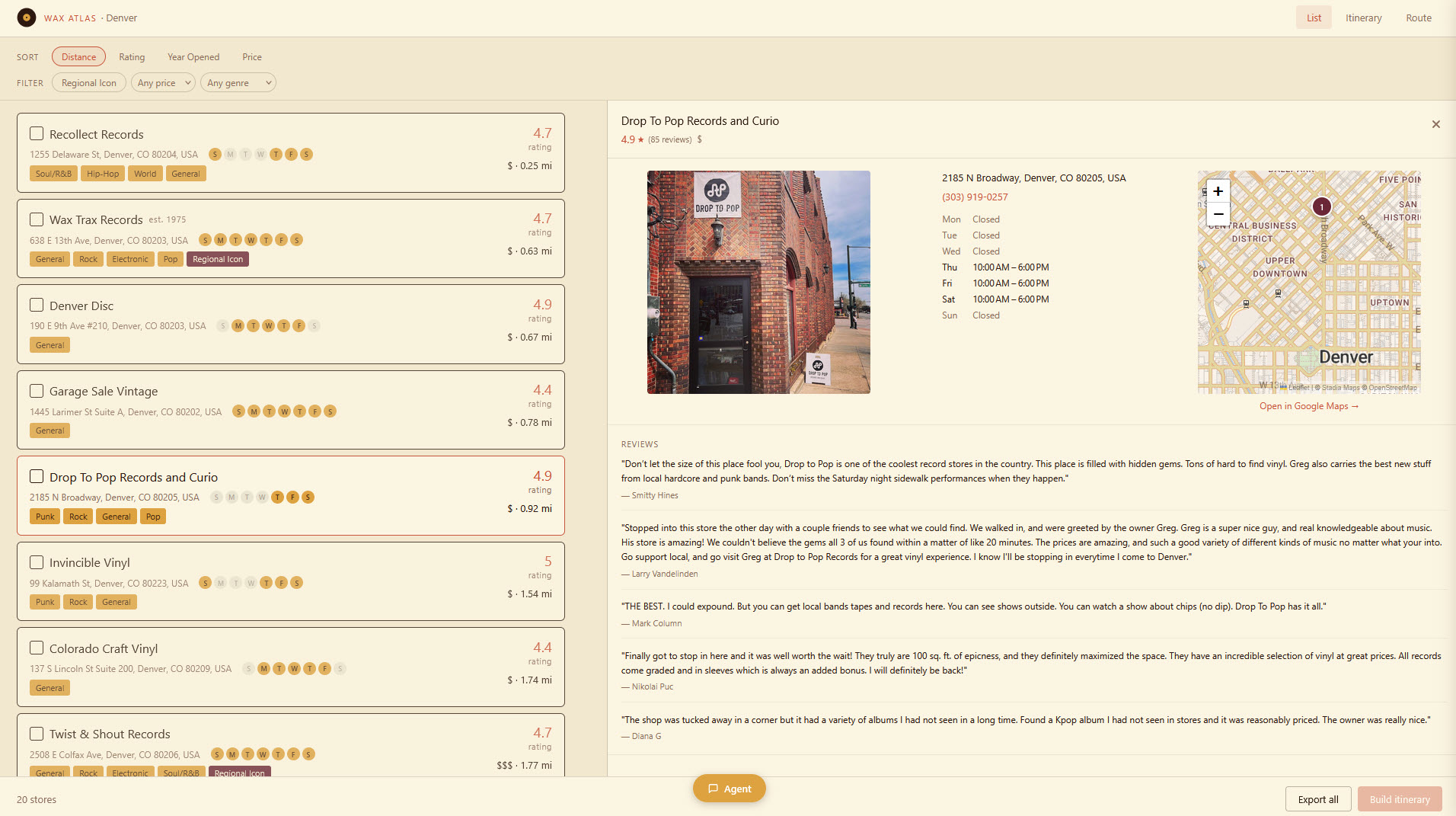
List view with store details
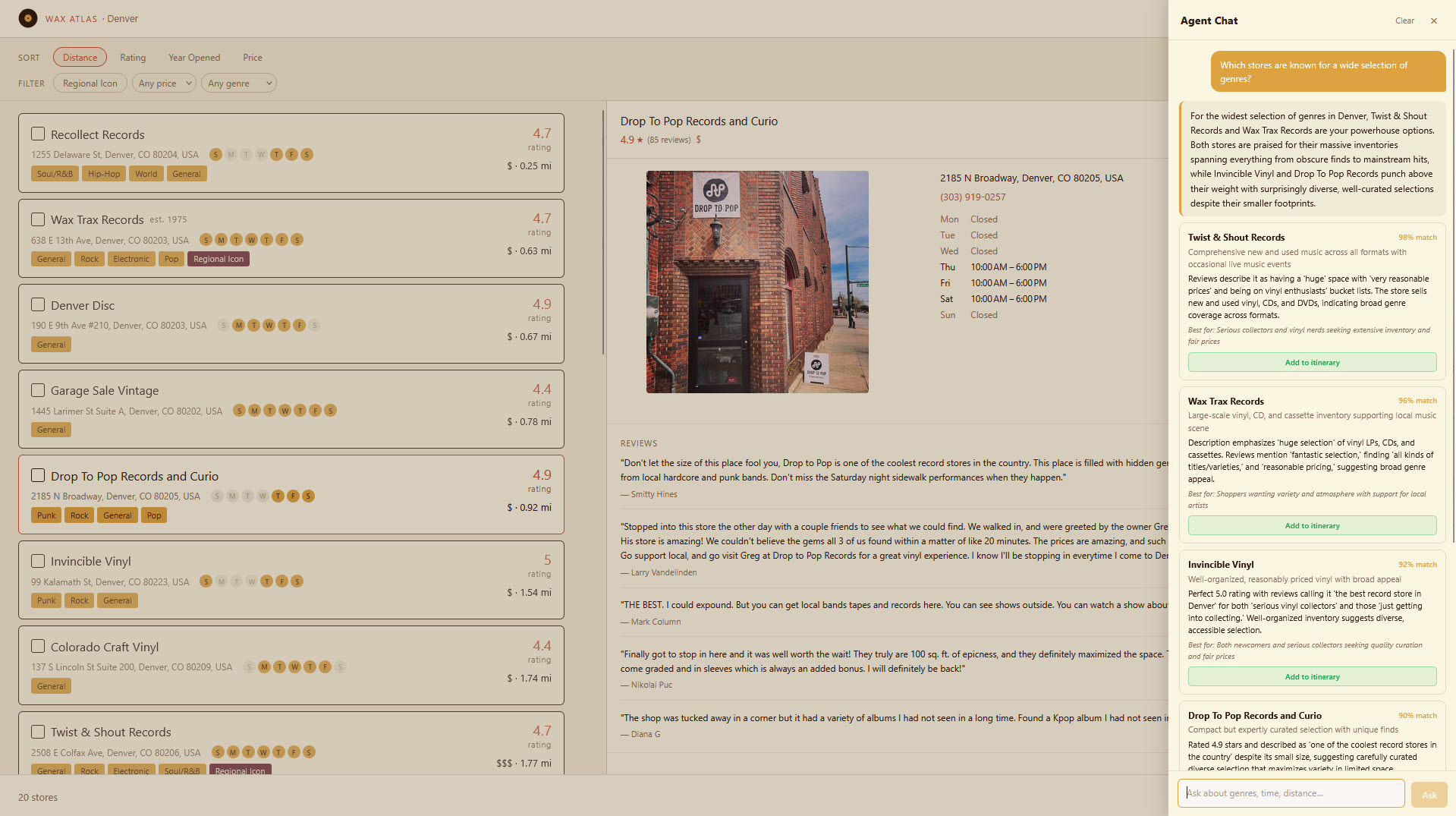
List view agent chat
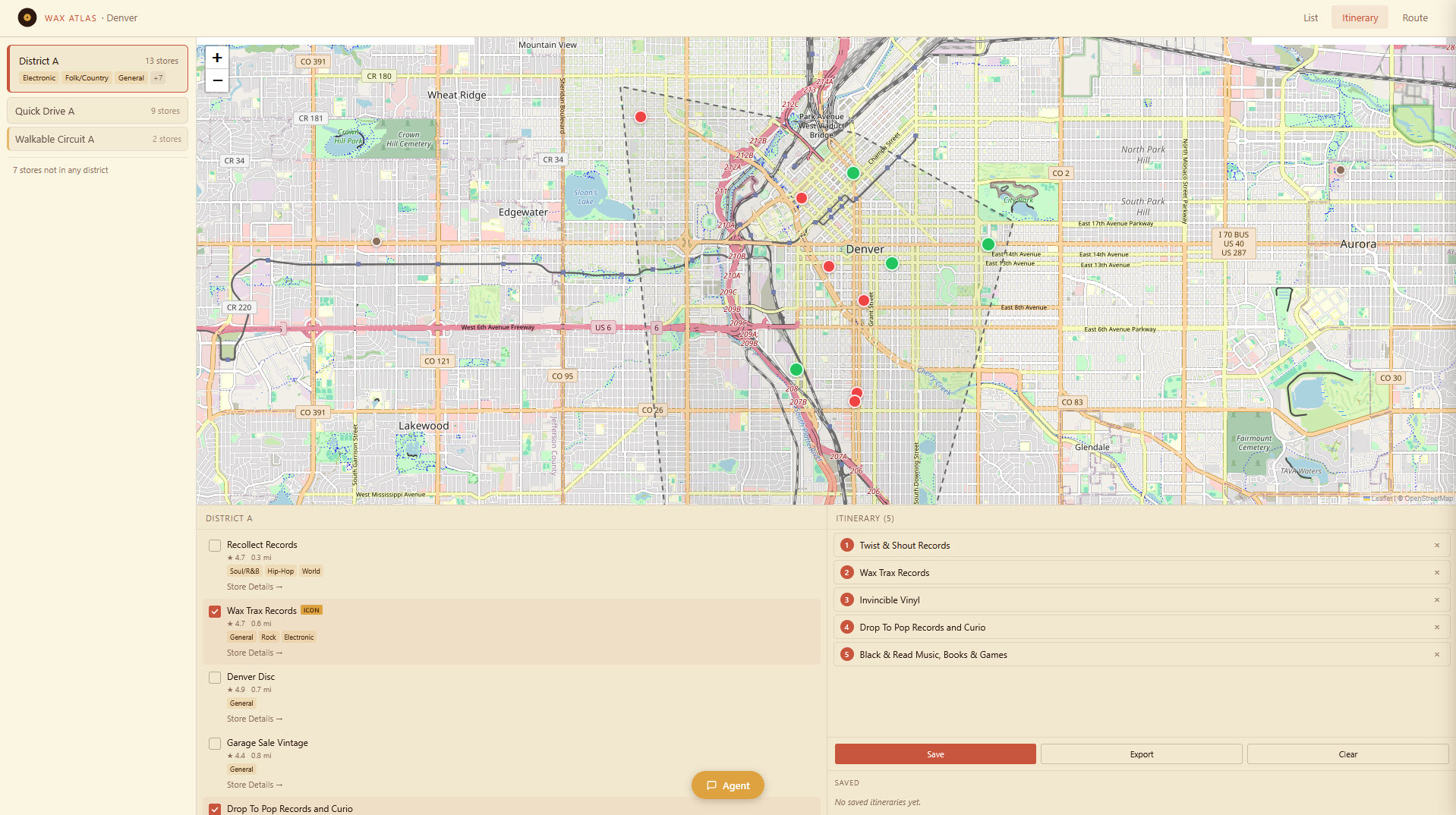
Itinerary builder
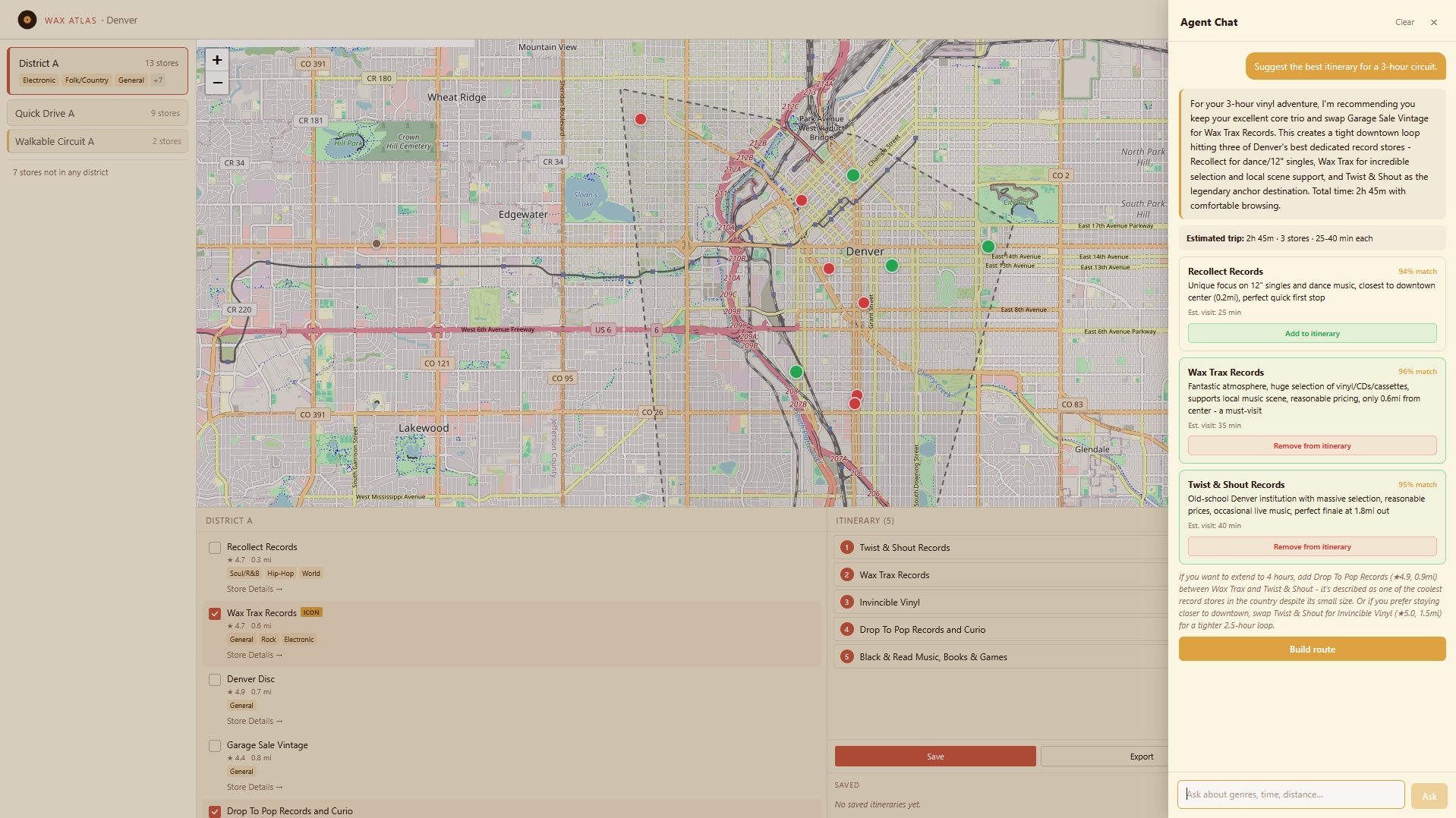
Itinerary builder agent chat
Route optimizer
Route optimizer agent chat
Stack Overview
Wax Atlas runs on a lightweight, interactive web stack optimized for real-time geospatial data and conversational AI.
→Frontend: React + Vite with Leaflet for interactive maps
→Backend: FastAPI as a thin API proxy
→AI: Claude (Anthropic) with CrewAI for multi-agent reasoning
→Data: Google Places API for store discovery; SQLite cache for performance
Wax Atlas ingests store data from multiple sources (Google Places API, manual curation) and surfaces
it through three interactive lenses: List view (browse by district/genre), Itinerary (curate the
stores you want to visit), and Route Planner (optimize your route to maximize time and fun). When
you ask the agent a question, such as "Which stores have the best indie rock?", Claude reasons over
the full store dataset (descriptions, reviews, genre tags) and returns ranked recommendations with
explanations. Route optimization uses the Directions API to calculate travel times between selected
stores and re-orders them to minimize your total journey while respecting constraints (time window,
travel mode, genre priorities).
AI Agent Design
The system uses Claude for two distinct tasks:
→Store Curation Agent: Reasons over store profiles to answer genre and vibe questions. Reasons across 20+ stores, each with reviews and descriptions, delivering ranked matches with specific reasoning.
→Route Optimization Agent: Analyzes store locations, travel time, and user constraints to propose optimal routes. Returns both reordered itineraries and detailed turn-by-turn directions.
Both use prompt caching to reduce token costs on repeated queries within a session (e.g., multiple
curation questions, route recalculations).
Cost Architecture
At current scale (~100 stores per city), each curation query costs ~$0.012–0.020 using Claude Sonnet.
Route optimization costs ~$0.015–0.035 depending on complexity. Full session (3–4 agent interactions)
runs ~$0.06–0.10. Places API calls (~$0.015 each) are cached aggressively. Prompt caching reduces
repeated interaction costs by up to 90% within active sessions, keeping user-facing costs under $0.15
per discovery session.